UNLOCKING THE VAST POTENTIAL OF THE LITHIUM METAL BATTERY
PURE LITHIUM’S NEXT GENERATION BATTERY
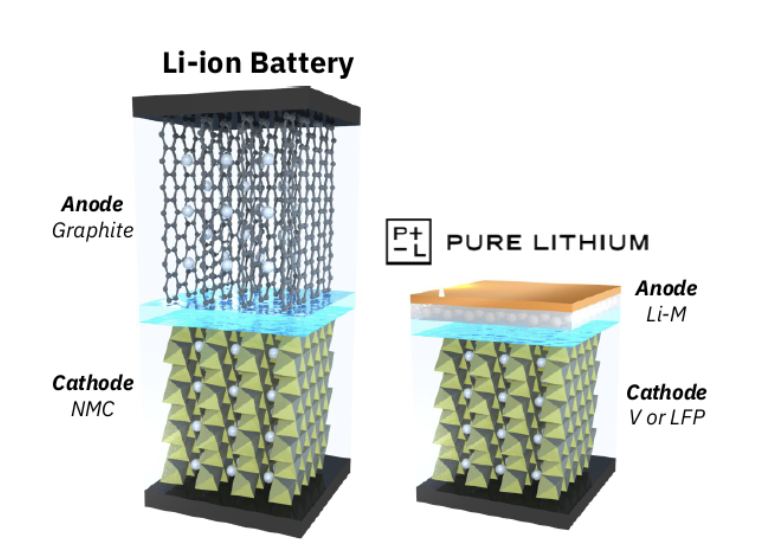
Pure Lithium’s proprietary lithium metal anode is paired with two different cathodes to create the next generation of lithium batteries.
The anode enables longer battery lifespan, higher energy density, and more safety.
Gen-1 Li-LFP Battery
The Gen-1 battery combines our patented Li-M anode and electrolyte with commercially available LFP cathode material, resulting in:
$29/kWh on a materials level
6,000+ cycles of cycle life
300 Wh/Kg of energy density
Gen-2 LV Battery
The Gen-2 battery combines our patented Li-M anode, vanadium cathode, and electrolyte, resulting in:
$29/kWh on a materials level
1,000+ cycles of cycle life
425 Wh/Kg of energy density
Simply put, our batteries outperform market leading technologies on energy density, lifespan, and cost. Furthermore, our LV battery remains stable up to 1800C which provides a dramatically safer thermal profile.
robust Intellectual Property
Pure Lithium shares a joint patent application with battery pioneer Sir M. Stanley Whittingham. Professor Whittingham won the 2019 Nobel Prize in Chemistry for the invention of the lithium-ion battery.
lithium metal vs lithium ion
The future of energy storage
Lithium metal offers about 10 times the capacity of a lithium-ion graphite anode which is needed to meet the growing storage demands.
Unable to meet the growing energy storage demand
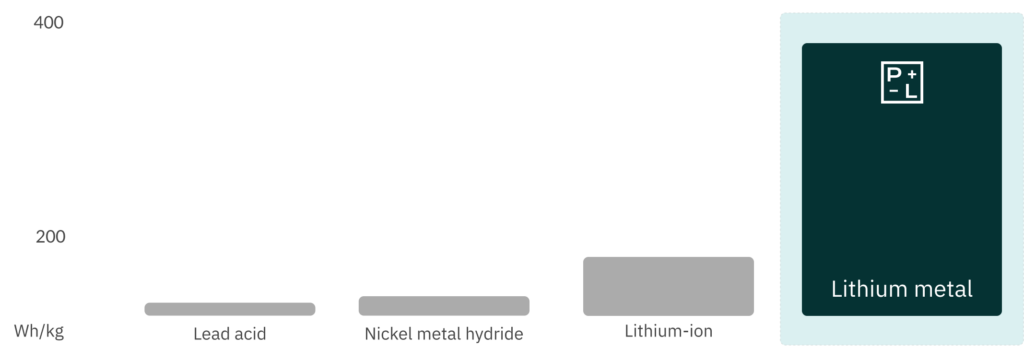
Today’s lithium-ion batteries were created over four decades ago and were never meant to meet the world’s energy storage demands. Lithium metal provides a higher step change in energy density.
a STEP CHANGE IN ENERGY DENSITY
Only two batteries in our lifetime have been commercialized to gigawatt-hour scale: lead-acid and lithium ion.
Lithium metal is next and will replace the lithium ion battery.
BRINE TO BATTERY™ REVOLUTIONIZES PRODUCTION
Our Brine to Battery™ technology revolutionizes battery production by combining lithium extraction and anode production into a single, vertically integrated process. This enables fast, inexpensive, safer, and more sustainable manufacturing of battery-ready lithium metal anodes at a commercially viable cost of approximately $15/kWh.
Using widely available lithium brine, we electrodeposit highly pure lithium metal directly onto a copper substrate, forming a full battery anode in a single step, thus bypassing traditional lithium compound production and eliminating multiple costly and energy-intensive processing stages.
Pure Lithium is the only company to combine lithium metal extraction and anode production in this way, unlocking a fundamentally new supply chain model that delivers lower cost, faster time-to-production, and a greener pathway to large-scale lithium metal batteries.
Lithium Metal Electrodeposition
Pure Lithium’s proprietary polymer membrane conducts only lithium and protects the lithium metal anode from water. Our process deposits ultra-thin, 99.9% pure lithium metal onto a substrate directly from brine. This is completely different than direct lithium extraction (DLE), which cannot produce lithium metal.
Direct lithium extraction (DLE) refers to a combination of processes that may include ion-exchange, precipitation, solvent extraction, elution and heating. Electrodeposition is a fast, one-step electrochemical process.
DLE, which has not been deployed commercially, is a way to produce traditional lithium compounds – lithium carbonate and lithium hydroxide – from brine for use in lithium-ion battery. Imagine a needle in a haystack: DLE removes all the hay to leave a needle. Pure Lithium’s electrodeposition technology removes only the needle (lithium) and leaves everything else behind.
DLE on average consumes 2,800 cubic meters of fresh water per ton of lithium carbonate (Li2CO3) produced. The process produces lithium salts, which are then inserted into “pre-cam” and made into cathode active material that becomes the lithium source in a lithium-ion battery.